
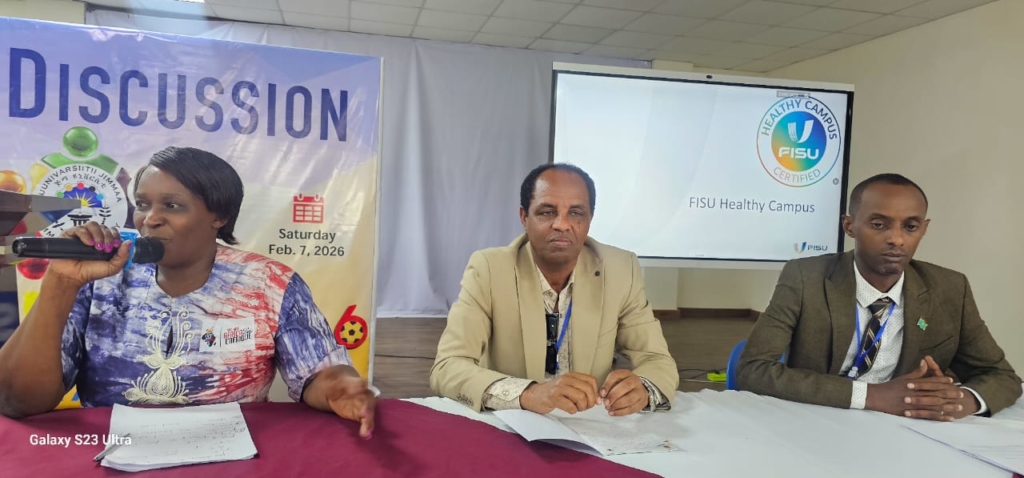
The presentation held alongside the Ethiopian University Sports Festival at Jimma University showcases FISU’s commitment to strengthening structured health and wellbeing systems within universities worldwide.
The presentation was delivered by Peninnah Kabenge Aligawesa (Uganda), FISU Vice President, attending as the official representative of FISU President Leonz Eder. Mrs. Kabenge also serves as Secretary General of the Federation of Africa University Sports (FASU).

Importantly, the session brought together the leadership of the 47 Ethiopian universities participating in the Festival, including University Presidents, Deans of Students, Directors of Sports, and members of the Executive Committee of the Ethiopian University Sports Association. The presence of institutional decision-makers provided a strategic platform to advance dialogue on structured implementation of the Healthy Campus framework.
Strengthening Global Standards in Local Contexts
Prior to introducing the programme, Penninah Kabenge provided an overview of FISU’s mandate and flagship initiatives, highlighting the federation’s role in advancing university sport, education, health, and student development globally.
She then presented the FISU Healthy Campus Programme, a global framework designed to enhance the physical, mental, and social wellbeing of students and campus communities through measurable standards and internationally recognised certification.
The presentation outlined:
- The global expansion and reach of the programme
- The objectives and governance of the Healthy Campus initiative
- The development and structure of the FISU Healthy Campus Standard
- The programme’s seven domains of health and wellbeing
- The 100 criteria enabling structured yet flexible institutional implementation
- The digital platform supporting monitoring, benchmarking, and certification
The FISU Vice-President emphasised that Healthy Campus is not a “yes-or-no” initiative, but a progressive system offering five certification levels from entry to platinum. allowing institutions to advance at their own pace.
“The discussions earlier in the conference showed that I was preaching to the already converted,” remarked Peninnah Kabenge Aligawesa, FISU Vice President. “The commitment to student welfare is clearly present. What is required now is structured leadership endorsement to translate that commitment into measurable, internationally recognised impact.”
“The discussions earlier in the conference showed that I was preaching to the already converted,” she remarked. “The commitment to student welfare is clearly present. What is required now is structured leadership endorsement to translate that commitment into measurable, internationally recognised impact.”
Strategic value for universities
Addressing the strategic relevance of the programme, Mrs. Kabenge highlighted that Healthy Campus enables universities to contribute directly and measurably to the United Nations Sustainable Development Goals (SDGs) an increasingly important component of institutional accountability and international positioning.
She noted that the programme supports institutional learning from global best practices while allowing adaptation to local realities. By fostering coordination across departments and services, Healthy Campus embeds wellbeing within an institution-wide framework rather than isolated initiatives.
Improved campus life and strengthened student wellbeing can enhance engagement and retention, while international certification increases institutional credibility, visibility, and global recognition. Beyond certification, the programme supports research, impact measurement, comparative analysis, and continuous improvement.
Advancing FISU’s Regional Development Strategy
The engagement in Jimma aligns closely with FISU’s broader regional development strategy, which seeks to strengthen capacity, governance, and programme implementation across all continental university sport structures. By working directly with university leadership and national university sports associations, FISU continues to promote structured, standards-based development that integrates sport, education, and wellbeing.
The strong participation of Ethiopian institutions signals growing momentum in Africa and reinforces the role of Healthy Campus as a strategic entry point for sustainable university sport development within the global FISU ecosystem.
Related News
Meet five truly inspirational women from the university sports movement