
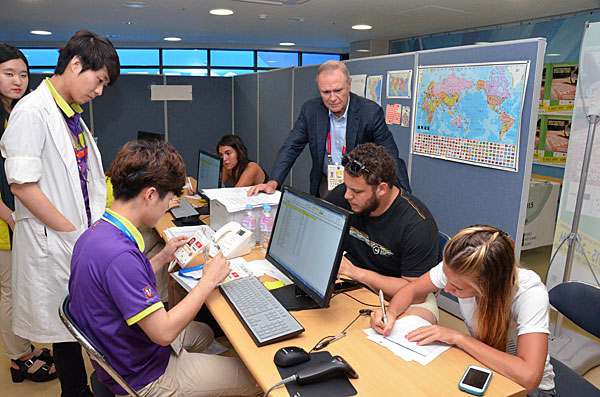
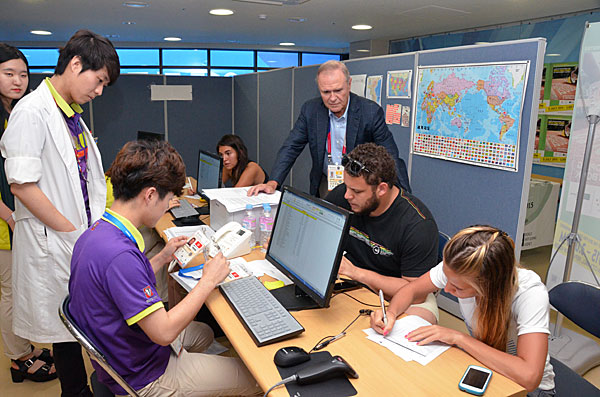
GWANGJU – During the 28th Summer Universiade Gwangju 2015, student-athletes from over 130 countries had the opportunity to undergo an extensive cardiac evaluation. “This is the largest cardiac evaluation of international athletes ever”, Doctor Lawrence Rink, Chair of the FISU Medical Committee and Director of the ‘Check-Up Your Heart’-Programme states. “Sudden Death of a University athlete is almost always related to a cardiac abnormality. The most common cause of sudden death in an athlete is almost always related to the heart. This appears to be more common in basketball players and football (Soccer) players, Afro-American athletes and males predominate.”
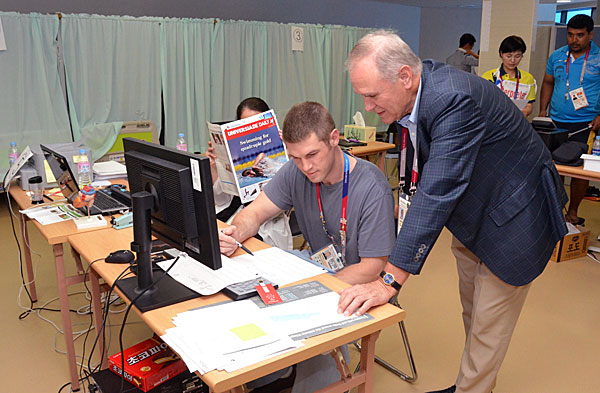 Dr. Hornsby & Dr. Rink
This study is designed to provide a comprehensive heart exam for athletes from throughout the world, most will never have an opportunity to have an evaluation of this type in their own country. This comprehensive exam included measurements of body fat and body composition, height, weight, blood pressure, wing-span, a 15 part questionnaire translated in multiple languages, a complete echocardiogram and an electrocardiogram. Dr. Kyle Hornsby, former Indiana University basketball player and cardiologist, Dr. Kye-Hoon Kim and Dr Jae-Young Cho are Sports Cardiology experts and reviewed the results with each athlete. Another major advancement of this programme is that each athlete has been provided with a USB memory stick which includes their results. They can take these back to their home country to have their own physicians reviewed that data.
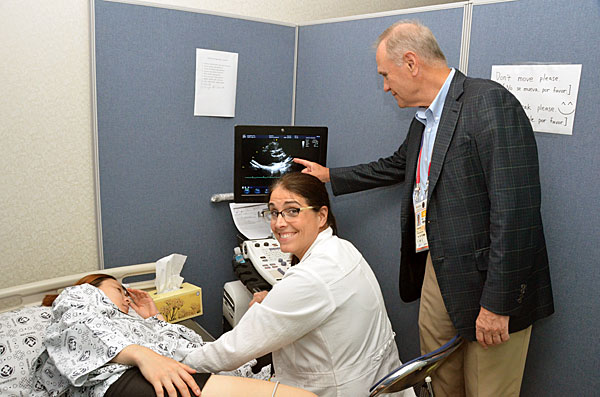
The very detailed scientific data collected will be reviewed by cardiology experts from the University of Michigan and Indiana University in the USA and by the research department from the Chonam National University Hospital in Korea. This data will be correlated with information collected during the 27th Summer Universiade in Kazan, Russia 2013. Approximately 10% of the athletes will have significant abnormalities but less than 0.1% would be expected to have serious abnormalities requiring intervention.
Dr. Rink states that this data will be a very valuable addition to information already known about athletes and is expected to help decrease sudden death and athletes in the future and to be able to decrease the cost of pre-participation evaluation of athletes in the future.
FISU Medical Committe