
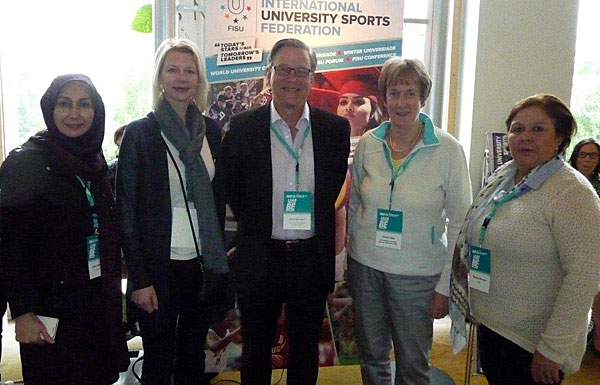
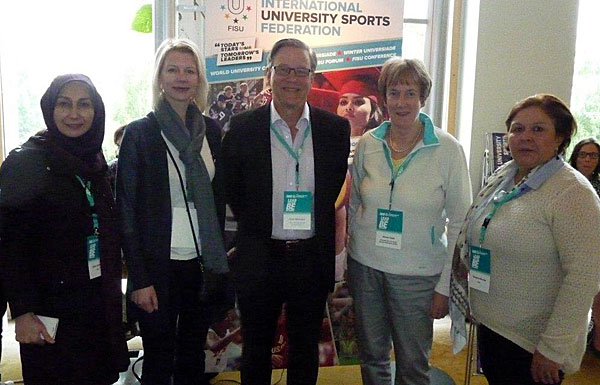
 From left to right: S. Limoochi, K. Ulp, R. Nieminen, A. Odell and R. Mendez Gamboa
HELSINKI – Due to the partnership with IWG, a parallel session was run by FISU. Its title was “University Sport: A constant quest for quality.” This session allowed FISU delegates to not only present FISU as a sports organisation (A. Odell and P. Kabenge, EC members) but also the structures and actions of FISU that contribute to the development of gender policy within FISU (R. Mendez Gamboa, EC member & Chair of the Committee for Gender Equality) as well as contributing to the development of people who are role models for future generations (N. Campos & L. Uutinen, Student Committee members). It was also important for FISU to evoke the daily sports activities at University, in casu that of the University of Tehran Alzahra (S. Limoochi, Member of the Committee for Gender Equality). The session that was leaded by Hilkka Laiteinen ended with the screening of the film made for the occasion, entitled “Gender Equality in FISU” .
The next IWG Conference will be held in 2018 in Botswana.
Kolë Gjeloshaj
Find here the Legacy document
Presentation of the Video: Women in university sport are real role models in society
“Worldwide, the enrolment of women in higher education now exceeds that of men. Women’s participation in higher education as a result of the expansion of both capacity and opportunity has increased six fold during the last forty years.”(1) Additionally evidence is emerging that women’s practice of sport and physical activity at both recreational and competitive levels across a wide range of disciplines in also increasing. In many countries, sport is not necessarily a compulsory subject in higher education institutions, but is provided alternatively as a service: where such service is driven by innovation and creativity, participation in sport and physical activity can become a platform through which to develop tools for education and personal development, and opportunities which promote and guarantee the involvement of women in sporting activity, sporting organisation, leadership, and associated business and outreach activity through sport.
The number of women attending higher education institutions continues to increase worldwide, as well as their practice of sport and physical activity at both leisure and competition levels across a diverse range of disciplines. In many countries, higher education institutions where sport is not a compulsory subject often act as platforms that offer, through innovation and creativity, the opportunity to develop tools (managerial, technical, social….) promoting and guaranteeing the involvement of women in sports activities and organisations.
The challenges faced by higher education institutions are, amongst others: how to ensure that young women remain involved in sport in a long-term perspective after they complete their studies or sports career; how to integrate sport in women’s career development, e.g. it is no longer discussed that by being involved in sports activities, young people acquire leadership skills?
What policies could be developed to foster young women’s representation and continued involvement in the university sports movement, while ensuring a better gender balance? How the existing rules and policies implemented by some higher education institutions or organisations such as FISU in their sports and education activities can be implemented outside of the sports area, in order to impact social communities and society as a whole?